
Unfair updates your recommendations when the inputs behind them change in a meaningful way, not every time you make a tiny edit, so it is normal for the top result to stay put until your profile, feedback, activity, or recent logging adds a clearer signal.
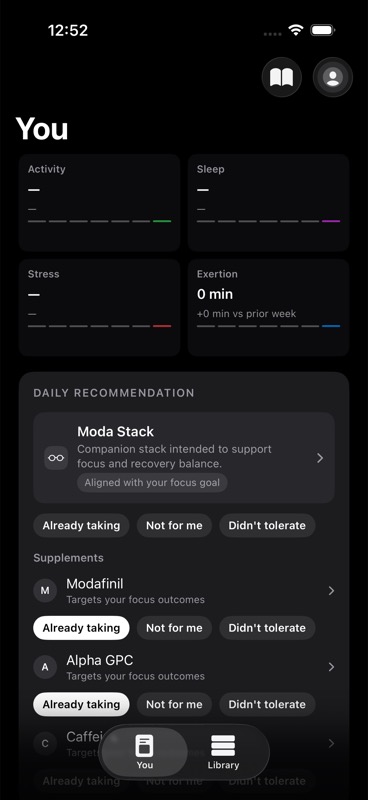
Unfair does not use a simple "refresh after every tap" rule. The app stores the last recommendation bundle, compares it against your current recommendation inputs, and only recalculates when those inputs changed, when no recommendation bundle exists yet, or when the recommendation engine or library version changed.
When recommendations usually update
In practice, recommendation checks happen in a few common places:
- During onboarding, when Unfair loads recommendations for your current profile
- When the You screen loads and the app compares your current inputs with the last saved recommendation inputs
- After recommendation feedback on the You screen, such as marking something as Already taking, Not for me, or Didn't tolerate
- After changes to favorite stacks or favorite supplements
- After activating, updating, or deactivating an active stack
- After dose journal activity, because Unfair recomputes your recent 30-day adherence from taken and skipped events
- After experiment history changes that create a clear keep signal or update the avoid list used in recommendations
If none of those signals changed in a way the system uses, the existing recommendation bundle stays in place.
Which changes tend to trigger recalculation
The changes most likely to matter are the ones that feed directly into recommendation inputs.
Profile changes that matter most
These usually trigger a new recommendation calculation because they change the recommendation profile itself:
- Your primary supplement goal
- Your stimulant sensitivity
- Whether you reported contraindications or current medications
- Your current supplements
- Your cycle preference
- Your obstacles
These are stronger signals than cosmetic profile edits like your name or photo.
Behavior and plan changes that matter
Unfair also uses behavior and plan context, not just profile answers. Recalculation is more likely after you:
- Favorite or unfavorite a stack or supplement
- Start or stop a stack
- Mark a recommendation as already covered, not a fit, or poorly tolerated
- Finish an experiment and keep the intervention
- Add an item to the experiment avoid list
- Build enough recent dose logging for your 30-day adherence picture to change
That last point matters because adherence is not inferred from one isolated action. The recommendation refresh coordinator only uses a 30-day adherence value when there are at least four relevant taken or skipped dose events in the last 30 days.
Why a small edit may not change what you see
A recalculation does not guarantee a visibly different top recommendation.
That can happen for a few reasons:
- Your edit changed something real, but not enough to outrank the current top stack
- The change affected lower-ranked candidates more than the first one
- Your recent behavior still points strongly toward the same recommendation
- You logged only a little new data, so the adherence signal did not move much
- The app refreshed, but the best answer remained the same after scoring
So the right question is usually not "Did it refresh?" but "Did my new input change the recommendation inputs enough to alter the ranking?"
If the top recommendation still feels stale
If the top card still does not feel current, use the strongest signals the app actually listens to.
Start with explicit feedback
On the You screen, give feedback on the recommendation itself when it applies:
- Already taking if you are already using it
- Not for me if it is not a fit
- Didn't tolerate if you tried it and the experience was poor
That feedback is part of the recommendation behavior snapshot and forces a fresh recommendation pass on the You screen.
For more on what those options mean, see Rationale and Feedback.
Then update the inputs that actually shape recommendations
If your situation changed, update the parts of your profile that the recommendation engine uses most directly:
- Goal
- Stimulant sensitivity
- Current supplements
- Cycle preference
- Obstacles
- Contraindications or current medications
If you want the app to understand what is already working for you, make sure your active stacks, favorites, and relevant experiment outcomes are also up to date.
If logging changed but recommendations did not
Dose logging can matter, but only when it changes the recent adherence signal enough to matter.
A single taken dose or one missed entry may not move the visible recommendation. More consistent logging is more useful than isolated corrections, especially when it changes your last 30 days from "not enough signal" to a real adherence pattern.
What to do next
If your recommendation still feels off:
- Leave direct feedback on the stale recommendation in You
- Update the recommendation-driving profile fields, not cosmetic profile details
- Make sure your active stacks and favorites reflect what you are actually doing now
- Keep logging taken and skipped doses consistently if your routine changed
- Reopen the You screen and review the updated recommendation card and rationale
If you want a deeper explanation of how Unfair builds recommendation output, see AI Recommendations. If you want help understanding the explanation attached to a result, see Rationale and Feedback. If you want the day-to-day workflow around your top recommendation, see Daily Recommendation Review.